Partnership for Peace and Security or an Expert Perspective on Cooperation between ISRS and the UN Office of Counter‑Terrorism
Thanks to the proactive foreign policy of the President of Uzbekistan, Shavkat Miromonovich Mirziyoyev, relations with the United Nations (UN) and its specialized agencies have been strengthening year after year.
This policy is reflected not in passive responses, but in the country’s active, initiative‑driven, and constructive engagement in addressing the most pressing international and regional challenges, particularly in the field of peace and security.
An example of such cooperation is the collaboration between the Institute for Strategic and Regional Studies under the President of the Republic of Uzbekistan (ISRS) and the United Nations Office of Counter‑Terrorism (UNOCT).
Initiative and Global Engagement
In recent years, the Institute for Strategic and Regional Studies under the President of the Republic of Uzbekistan (ISRS) has begun making an active contribution to the development and implementation of effective counter‑terrorism measures tailored to the regional context of Central Asia.
The foundation of this partnership was the joint organization of an international conference in March 2022 in Tashkent on “Regional Cooperation of Central Asian States within the Framework of the Joint Plan of Action for the Implementation of the United Nations Global Counter‑Terrorism Strategy”. This event was a direct and practical realization of the historic initiative put forward by President Shavkat Mirziyoyev at the 75th session of the United Nations General Assembly.
Following the conference, the Tashkent Declaration was adopted and subsequently designated an official document of the 76th session of the United Nations General Assembly, along with the updated Joint Plan of Action for the Implementation of the United Nations Global Counter‑Terrorism Strategy in Central Asia (JPoA).
Since then, ISRS has regularly served as a co‑organizer or participant in significant international counter‑terrorism events convened under the auspices of the United Nations Office of Counter‑Terrorism (UNOCT).
In May 2022, in Málaga, Spain, at a high‑level international conference, UNOCT, together with ISRS and the United Nations Regional Centre for Preventive Diplomacy for Central Asia (UNRCCA), launched a comprehensive e‑learning course on counter‑terrorism, human rights, and the rule of law.
In July 2024, the ISRS Director, Eldor Aripov, participated in the UNOCT quarterly briefing for Member States for the first time. The discussion of current trends, priority issues, and the implementation of the UNOCT mandate demonstrated the integration of Uzbek expert perspectives into the global security dialogue.
ISRS’s participation in UNOCT briefings and joint events ensures a regular, substantive, and constructive dialogue with the international community, reinforcing Uzbekistan’s position as a reliable partner on regional and global security issues.
Foundation and Key Directions of Cooperation
A defining milestone that solidified the strategic character of the relationship was the signing, on 5 December 2023 at the United Nations Headquarters in New York, of a Memorandum of Understanding between the Institute for Strategic and Regional Studies under the President of the Republic of Uzbekistan (ISRS) and the United Nations Office of Counter‑Terrorism (UNOCT). This document formally established the partnership framework, enabling ISRS to join the “group of privileged partners” of the United Nations in the field of counter‑terrorism cooperation.
The cooperation is centered on the following key areas:
– intensive exchange of expert assessments and research findings on preventing and countering extremism and terrorism, with a particular focus on identifying and addressing their root causes;
– joint efforts toward the practical implementation of all four pillars of the United Nations Global Counter‑Terrorism Strategy in Central Asia;
– organization and facilitation of high‑level conferences, seminars, and roundtables aimed at strengthening the coordination of regional states and international partners.
The partnership is also advancing in line with the “Roadmap” between the Republic of Uzbekistan and UNOCT for 2024-2025. Within this framework, innovative initiatives are being successfully introduced, including projects to counter the misuse of emerging technologies for terrorist purposes and to combat the financing of terrorism, as well as efforts to establish an effective early-warning network in counter‑terrorism.
Practical Solutions to Challenges and International Innovations
The cooperation between the Institute for Strategic and Regional Studies under the President of the Republic of Uzbekistan (ISRS) and the United Nations Office of Counter‑Terrorism (UNOCT) is focused on the most complex and sensitive issues that require innovative and humanitarian approaches.
A leading example of this innovation is their joint implementation of projects on the comprehensive rehabilitation and reintegration of individuals returning from conflict zones. The launch, at the initiative of President Shavkat Mirziyoyev, of the Regional Expert Council on Rehabilitation and Reintegration in Central Asia (REC), in partnership with UNOCT, represents the first model of its kind in global practice. This council brings together more than 40 highly qualified experts from Central Asian states, including representatives of law enforcement and judicial bodies, psychologists, theologians, medical professionals, and social workers.
The project’s significance is underscored by the participation of respected international organizations, including the Organization for Security and Co‑operation in Europe (OSCE), the Global Community Engagement and Resilience Fund (GCERF), and the International Institute for Justice and the Rule of Law (IIJ).
The activities of the REC have been presented on key United Nations platforms – on 11 November 2024 in Geneva, 10 December 2024 in New York, and 21 May 2025 in Vienna – highlighting its growing international recognition.
Currently, to implement the Head of Uzbekistan's proposal, ISRS, together with UNOCT, is actively working to transform the Regional Expert Council into an International Competence Center, which will significantly enhance its global impact and further strengthen international cooperation in addressing the challenges of rehabilitation and reintegration.
Synergy of National Experience and Global Expertise
The partnership between the Institute for Strategic and Regional Studies under the President of the Republic of Uzbekistan (ISRS) and the United Nations Office of Counter‑Terrorism (UNOCT) is a striking example of effective synergy between Uzbekistan’s robust national expertise and the UN’s advanced international experience.
Such cooperation underscores Uzbekistan’s role as an active, constructive, and responsible participant in international efforts to maintain peace and security, while significantly enhancing the country’s expert and analytical capacity within the global counter‑terrorism agenda.
This engagement serves as a concrete and practical instrument for implementing the proactive, multilateral, and pragmatic foreign policy championed by President Shavkat Mirziyoyev. Within the framework of the “New Uzbekistan” strategy, countering extremism and terrorism is considered not merely a matter of national security, but a fundamental cornerstone of sustainable societal development. In essence, this policy represents a harmonious combination of firmness and principled action with deep humanitarian concern, and the alignment of national interests with international openness.
The cooperation allows UNOCT to benefit from Uzbekistan’s unique and proven experience, which has strategically shifted the emphasis from purely force-based counter-terrorism measures to preventive approaches, including the social rehabilitation and reintegration of citizens returning from conflict zones.
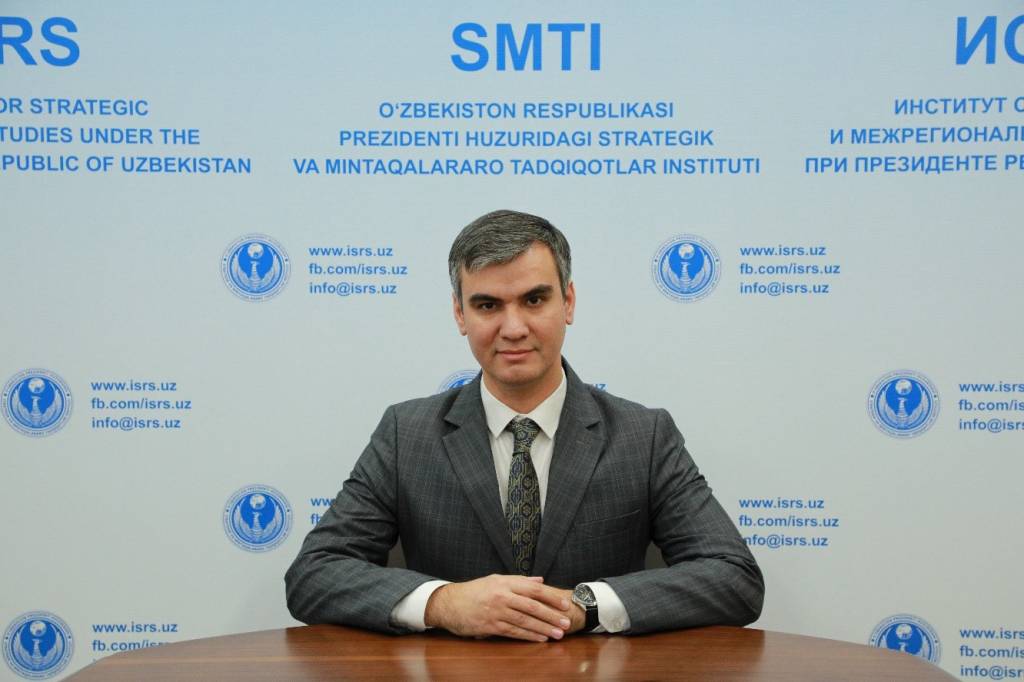
Timur Akhmedov,
Head of Department,
ISRS under the President of the Republic of Uzbekistan


